
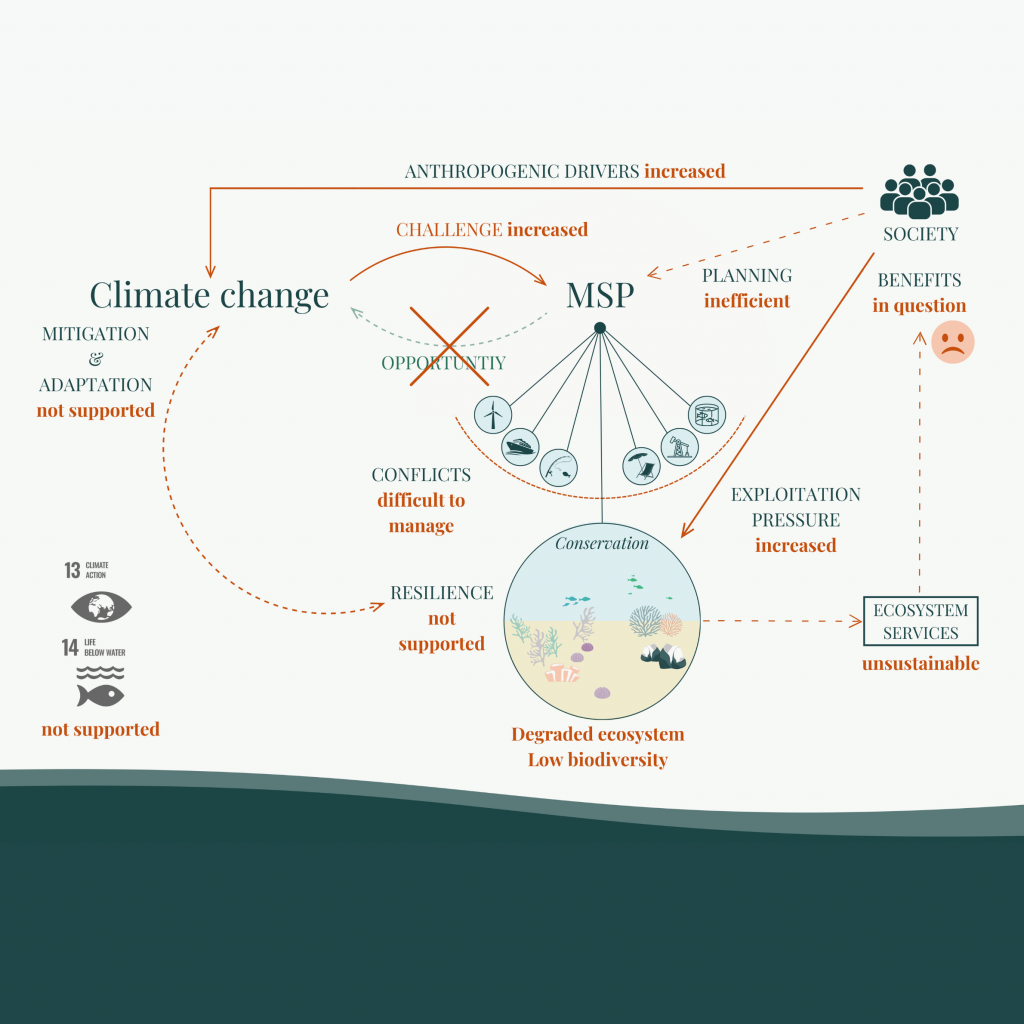
Marine spatial planning (MSP) is a powerful tool for managing ocean resources and uses, but too often climate change is treated as an afterthought, simply a challenge, rather than being truly integrated into the planning process. For MSP to be genuinely ‘climate-smart’, climate change must be addressed in the vision, aims, and objectives of a plan, with mechanisms for introducing climate data and evidence-based adaptive planning.
I am proud to have recently published the Climate-Smart MSP Framework to Support Biodiversity Objectives, presenting a harmonised and comprehensive framework to assess the extent to which MSP is climate-smart. This can be applied by researchers and planners to provide a baseline for evidence-based progress towards the widespread adoption of climate-smart planning across Europe and the world.
The Framework evaluates ‘climate-smartness’ across 5 key domains.
1. Assessing climate change considerations and an ecosystem-based approach
For truly climate-smart MSP, climate change should be addressed in the vision, aims, or objectives of the plan, rather than merely being considered a challenge, and MSP should be aligned with national or international climate policies, plans, and strategies.
An ecosystem-based approach is the cornerstone of climate-smart MSP, so understanding the extent to which this is applied, in principle and practice, is vital.
2. Assessing climate mitigation
MSP can be used as a tool to address climate change by allocating space for, or outlining, proposals for ocean-based mitigation actions.
Marine renewable energy infrastructure can contribute to national renewable energy and emission reduction goals. To support a holistic approach to mitigation, biodiversity should be taken into account in the development of this infrastructure, alongside the allocation of space for smart combinations and multi-use solutions.
3. Assessing climate adaptation
MSP can allocate space for, or outline, proposals for ocean-based adaptation actions, implemented to increase adaptive capacity, strengthen resilience and reduce
vulnerability to the impacts of climate change.
MSP should map habitats, ecological features and nature assets to support nature-based solutions and apply strategic biodiversity conservation. The inclusion of MPA networks and area-based restoration measures supports the alignment of MSP with relevant biodiversity frameworks and targets (EU BDS, 30×30, EU NRR), and identifying climate refugia supports climate resilience and adaptation.
To overcome barriers here, we need to:
💡 Support the mapping of nature values and ecosystem services.
💡 Compile evidence from successful pilot projects.
4. Assessing the integration of climate-related knowledge
One of the biggest barriers to climate-smart MSP is the integration of climate-related knowledge (climate impacts, risks, and opportunities) to analyse future conditions and anticipate the effects of climate change.
For example, through scenario analysis to develop plausible descriptions of the future. This might be species distribution models or more complex ecosystem or ecological models. Climate-sensitivity mapping can also be used inform the degree to which a species or ecosystem
responds to climate change.
To overcome barriers here, we need:
💡 Climate change research to be designed with applicability to MSP in mind.
💡 Dedicated DSTs to integrate climate-related knowledge.
💡 Knowledge-sharing and learning from good practices.
5. Assessing monitoring and adaptive approaches for management
Effective monitoring is required for evidence-based adaptive planning in a changing climate, and adaptive, dynamic management approaches help manage the changing distributions of ocean resources and uses. However, climate change indicators are often missing from monitoring programmes. Furthermore, these indicators are rarely applied within structured, iterative frameworks to enable truly adaptive management.
To overcome barriers here, we need to:
💡 Invest resources into monitoring and evidence generation.
💡 Apply climate change indicators into pre-defined protocols for adaptive management.
A valuable new tool for climate-smart MSP
“We are all aware that the world is changing. In the face of the climate and biodiversity crises, climate-smart MSP offers a unique opportunity to champion ecosystem protection and promote climate action, to facilitate the sustainable use of marine resources into the future. We present the Climate-Smart MSP Framework to Support Biodiversity Objectives as the first comprehensive and systematic assessment tool to evaluate the integration of climate-smart and biodiversity-inclusive principles and practices in MSP, as an important step towards achieving this ambition.”
Source: Cross, N., Varjopuro, R., Calado, H. et al. The climate-smart MSP framework to support biodiversity objectives. npj Ocean Sustain (2026).
Read here: https://www.nature.com/articles/s44183-026-00205-1