

When you stand and look out at the ocean, does it feel like a part of you, or does it feel something distant, something ‘other’? Can you stand there and appreciate that the oxygen you are breathing, over half of it comes from the ocean? When you look at the calm surface, can you grasp the extent of the damage that humans have caused underneath? In looking to answer these questions, we hope to broaden our understanding of the ocean and our connection to it, we hope to become ocean-literate.
Ocean literacy
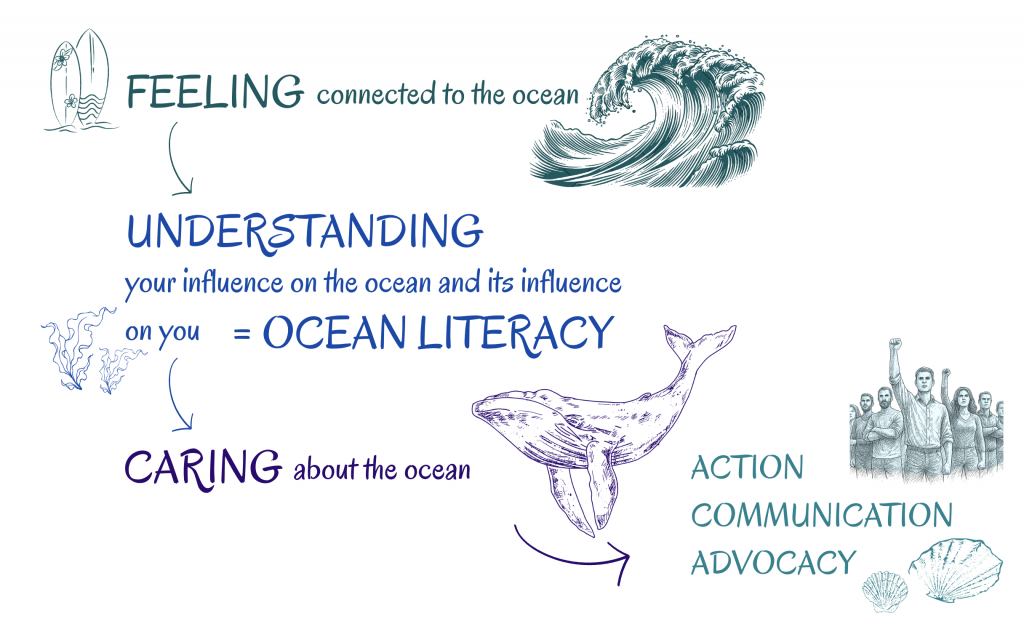
Ocean literacy is defined as “an understanding of your influence on the ocean, and its influence on you” [1].
It is a concept that resonates deeply with me, as a self-proclaimed ‘ocean-lover’ and someone who changed careers to study the ocean. Through education, a new profession, and continued exploration of the ocean, I seek to become literate. However, the idea of ocean literacy and the benefits it brings to individuals, society, and the planet should be accessible to everyone.
The concept of ocean literacy is relatively new, developed in response to the limited coverage of ocean sciences in formal education. But as momentum behind ocean literacy has grown in recent years, it is seen not just as an academic pursuit, but as something that can drive social, political and environmental change [2]. Education has the power to transform our relationship with the ocean, creating an inspired, ocean-literate society that can make informed decisions to keep the ocean healthy for generations to come [2,3].
Ocean literacy — driven by connection
It is sometimes suggested that the first step towards ocean literacy is to connect people to the ocean, but in reality, humankind is already undeniably, inextricably interconnected with the ocean. It makes the Earth habitable and supports biodiversity, it influences the climate and the weather we experience, and it is a source of food and oxygen [1,3]. We don’t need to work on being connected to the ocean — we already are.
For me, ocean literacy starts with realising that connection. When people feel connected to the ocean, when they witness its power, beauty and complexity, they want to learn more. They ask questions. They dig deeper into how ocean processes work, why marine ecosystems matter, and what is really happening beneath the surface. This investment in understanding, this drive to become informed, is ocean literacy in action.
However, the real power of ocean literacy lies not just in knowledge in isolation. Understanding changes people’s attitude and behaviour towards the ocean. People care. It becomes impossible to stay silent when the thing they love faces unprecedented threats from overexploitation and climate change. Through knowledge, understanding and lived experience, ocean literacy gives people the tools to communicate about the ocean in a meaningful way and empowers them to advocate for it.
PEOPLE WHO KNOW, CARE. PEOPLE WHO CARE, ACT.
Ocean literacy in the policy cycle
By promoting ocean literacy, we can prepare and empower our ocean stakeholders to engage and contribute to sustainable ocean management. We can leverage the power of an informed community. This might look like signing petitions, getting involved in campaigns, or considering the ocean when you vote. Something as simple as this, and you become an ocean advocate.
The goal (limitations of the current political system notwithstanding) is that this positively impacts policy. Here, ocean literacy must be used as a policy asset [4]. We must ensure that the government, marine planners and decision-makers are equipped to receive, value and utilise this knowledge. In turn, the successful implementation of policies that champion the ocean, marine biodiversity and the sustainable development of the blue economy require public acceptance and support, only truly possible if you have an ocean-literate society.
So, the next time you stand at the shore and notice the tide has shifted, or spot unfamiliar seaweed on the beach, or wonder why the waves are bigger on certain days, ask yourself the question: why? Why is that the case, and why does it matter? This curiosity, this simple act of questioning, is where ocean literacy begins. It is not reserved for marine scientists or policymakers; it belongs to all of us. It gives us all the power to be part of positive change for our blue planet.
References
[1] NMEA, ‘Ocean Literacy: The Essential Principles and Fundamental Concepts of Ocean Sciences for Learners of All Ages’, 2023. Available at: https://files.eric.ed.gov/fulltext/ED608847.pdf
[2] E. McKinley, D. Burdon, and R.J. Shellock, ‘The evolution of ocean literacy: A new framework for the United Nations Ocean Decade and beyond’ Marine Pollution Bulletin, Volume 186, 2023, doi: https://doi.org/10.1016/j.marpolbul.2022.114467
[3] IOC-UNESCO, ‘Ocean Literacy. Understanding. Caring. Acting’. Available at: https://oceanliteracy.unesco.org/about
[4] F. Soffietti, F. Carella, C. Jacob, C. Cervera Núñez, A. Kerninon, D. Brigolin, O, Laroussinie, and F. Musco, ‘Ocean Literacy as a Strategic Asset for Regional Marine Policy: Insights From an Implementation Case Study, Ocean and Society, 2, Article 9713, 2025, doi: https://doi.org/10.17645/oas.9713