

ORIGINALLY WRITTEN JUNE 2025.
My current research focuses on how marine planning and conservation can be future-proofed in a changing climate. How can it be made ‘climate-smart’? The effects of climate change in the marine environment must be well understood and applied to decision-making. If not, we are in the dark, and the effort we make now to ensure the sustainable use of marine resources may be wasted. So for now, the basics…
Climate change
Since the Industrial Revolution, the burning of fossil fuels, as well as cement production, agriculture and land use change (deforestation), has resulted in the accumulation of greenhouse gases (GHGs) in the Earth’s atmosphere [1]. GHGs alter the radiation flux and energy balance of the Earth. When solar radiation from the sun hits the Earth, it is absorbed, and some is re-emitted as longwave infrared radiation back into the atmosphere. GHGs absorb a portion of this infrared radiation, causing the vibration and rotation of molecules, and the generated thermal radiation is released back into the Earth’s atmosphere, resulting in warming [2], [3]. Carbon dioxide (CO2) is the most dominant GHG and accounts for roughly 65% of the radiative effect of GHGs. With an annual release of around 40 Gigatons (Gt) of CO2 each year (equating to 10.9 Gt of carbon), it is estimated that 2,500 billion Gt of CO2 has been emitted since the start of the industrial revolution [2]
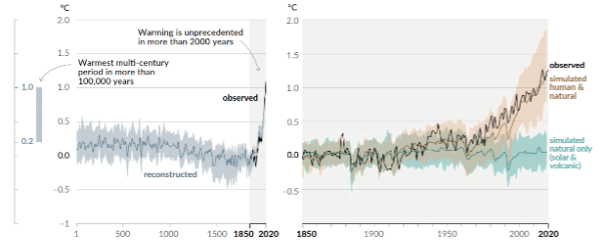
As such, human activity has resulted in unprecedented warming of the climate over the last 2000 years or more (Figure 1a), and has resulted in warming well above that modelled for natural only factors (no human influence) in recent years (Figure 1b) [4].
Climate change pathways
In order to assess the future risks and opportunities of climate change given the inherent uncertainty, the Intergovernmental Panel on Climate Change (IPCC) report uses scenario analysis to develop plausible descriptions of the future using GHG emissions as the primary driver of change [1].
Representative Concentration Pathways (RCPs) are a set of temporal plausible future concentrations, defined by their anthropogenic radiative forcing by 2100 relative to the year 1750 (in W m-2) [1]. Two main RCPs are used. RCP8.5 is the high GHG scenario, without effective climate change mitigation; RCP2.6 is the low GHG scenario, where climate change mitigation facilitates a two in three chance of limiting global atmospheric surface warming to below 2oC by 2100. Intermediate RCPs (RCP6.0 and RCP4.5) also exist, as well as a stringent RCP1.9 pathway to limit warming to 1.5ºC by 2100 [1]. Current emissions are in line with the RCP8.5 trajectory [1].
The IPCC’s Sixth Assessment Report (AR6) introduced Shared Socioeconomic Pathways (SSPs) as different plausible trends of socioeconomic activities that may shape future emissions [4]. The five scenarios are:
· SSP1–1.9 — Very low GHG scenario 1 leading to RCP1.9 by 2100
· SSP1–2.6 — Low GHG scenario 1 leading to RCP2.6 by 2100
· SSP2–4.5 — Intermediate GHG scenario 2 leading to RCP4.5 by 2100
· SSP3–7.0 — High GHG scenario 3 leading to RCP7.0 by 2100
· SSP5–8.5 — High GHG scenario 5 leading to RCP8.5 by 2100
Impacts of climate change
The effects of human-induced climate change are already being seen in the marine environment. The ocean can store four times the amount of heat as the air, resulting in over 90% of the additional heat in the atmosphere being held in the ocean. With long-term ocean warming, marine heat waves are becoming more frequent and of higher intensity. Acceleration of sea level rise (HC)* is caused by expansion due to this long-term ocean warming. In addition, warming has led to the melting and shrinking of the cryosphere** (VHC) which also contributes to sea level rise due to the influx of freshwater. In particular, with contributions from Greenland and Antarctic ice sheet melt to sea level rise (VHC). The melting cryosphere has additional impacts. Melting of the permafrost may result in the release of methane and CO2, GHGs, into the atmosphere. Plus, the melting of Arctic Sea ice reduces the albedo effect, a positive feedback for climate change [1].
*The IPCC report evaluates the confidence in the evidence: VLC = very low confidence, LC = low confidence, MC = medium confidence, HC = high confidence, VHC = very high confidence; and the likelihood of the outcome: VC = virtually certain (99–100% probability), VL = very likely (90–100%), L = likely (66–100%), ALN = about as likely as not (33–66%), U = unlikely (0–33%), VU = very unlikely (1–10%), EU = exceptionally unlikely (0–1%) [1].
**The cryosphere is the frozen components of the Earth System at and below the land and ocean surface [1].
There is considerable gas exchange between the atmosphere and the surface ocean, which is therefore a sink for atmospheric CO2 [2]. In fact, the ocean has absorbed 20–30% of the anthropogenic CO2 released since the 1980s (VL) [1]. This has disrupted the chemical equilibria, resulting in a decrease in pH, i.e., acidification [2]. The IPCC report states that ocean pH has decreased by 0.1 since the beginning of the Industrial Revolution (HC), which corresponds to an increase in acidity of 26% [1], but other sources estimate this increase in acidity to be as high as 40% [2]. Acidification reduces the saturation state of calcium carbonate, which impacts the survival of calcifying organisms that rely on calcium carbonate for their skeletons or shells, with knock-on effects on the entire food chain. The loss of keystone species such as reef-building corals has amplified effects for ecosystems and biodiversity [2], [4]. Although for low-emission scenarios, some extreme effects of acidification can be avoided, further acidification will continue in the future (VC) [1].
In addition to acidification, deoxygenation is an issue that has been identified across most of the global open ocean [1]. The warming of the surface ocean has reduced the solubility of oxygen (O2), resulting in lower oxygen concentrations. Oxygen depletion is also affected by increased stratification, limiting the transfer of O2 to the deep ocean, and increased microbial aerobic respiration, which utilises O2 and is accelerated by high temperatures and anthropogenic nutrient input [2]. Between 1970 and 2010, a global expansion of oxygen minimum zones of 3–8% was estimated (MC) [1]. Depleted oxygen represents a threat to the survival of many organisms, and thus to biodiversity, ecosystems, and ecosystem services, such as profitable fisheries [2].
Climate change impacts are widespread, with further examples including changes to large-scale ocean circulation, such as the weakening of the Atlantic Meridional Overturning Circulation (AMOC) (MC). Changes to ocean circulation would have important implications for global weather patterns and the water cycle. It can also contribute, alongside altered conditions such as temperature or oxygen saturation, to shifting species distribution (HC). Increased frequency and intensity of extreme weather events are likely (HC) and greater risk of coastal erosion and flooding, which threaten coastal ecosystems and communities. Habitats may be damaged or lost, potentially contributing to the release of carbon into the atmosphere, as seen with coastal wetlands, seagrass meadows, or kelp forests. Furthermore, the changes to the ocean and cryosphere described are expected to be irreversible on time scales relevant to human societies and ecosystems [1].
It is clear to see the threat that climate change represents to the health of ecosystems and to marine biodiversity. As described, the main drivers of ecosystem change (surface warming and acidification, oxygen loss, nitrate content and net primary production change [1] impact the survival of species, their distribution and phenology, population dynamics, as well as community structure and ecosystem function [5].
Efforts to combat climate change
Given the scope and severity of the climate crisis, an effective, multilateral response is needed to combat climate change. The Paris Agreement is an international, legally binding treaty under the United Nations Framework Convention on Climate Change, adopted in 2015 and entered into force in 2016, the main aim of which is to limit global warming. Specifically, to limit the temperature increase to 2°C, or if possible 1.5°C above pre-industrial levels. This will be done by reducing GHG emissions. Ambitions also include increasing the ability to adapt to the effects of climate change, and to foster climate resilience and low GHG development [6].
Under the Paris Agreement, Parties were required to set out their nationally determined contributions (NDCs) to achieve this common goal. NDCs include both climate change mitigation and adaptation actions. According to the Paris Agreement, mitigation activities result in reduced emissions of GHGs, whereas adaptation measures should be implemented to increase adaptive capacity, strengthen resilience and reduce vulnerability to the impacts of climate change [6].
However, projected GHG emissions, even if all declared NDCs are implemented, are still considerably different to modelled scenarios to achieve 1.5°C warming. The best estimates for the peak temperature rise before 2100 range between 2.1 and 2.8 °C, depending on the underlying assumptions [7]. Additionally, 2024 was confirmed to be the warmest year on record, and the average global temperature exceeded 1.5°C above pre-industrial levels. The Paris Agreement limit of 1.5°C is calculated over at least twenty years, and thus has not been broken, but 2024 provided considerable evidence of continued planetary warming. GHG emissions peaked, temperature records were broken for thirteen consecutive months, the hottest day ever recorded was observed, and several record-high ocean temperatures were seen [8]. This highlights the need for continued and redoubled efforts to limit warming and lessen the potentially catastrophic consequences of global warming.
References
[1] IPCC, The Ocean and Cryosphere in a Changing Climate: Special Report of the Intergovernmental Panel on Climate Change, 1st ed. Cambridge University Press, 2022. doi: 10.1017/9781009157964.
[2] R. Simmer, E. Jansen, K. Patterson, and J. Schnoor, ‘Climate Change and the Sea: A Major Disruption in Steady State and the Master Variables’, ACS Environ. Au, vol. 3, no. 4, pp. 195–208, Jul. 2023, doi: 10.1021/acsenvironau.2c00061.
[3] M. Filonchyk, M. Peterson, L. Zhang, V. Hurynovich, and Y. He, ‘Greenhouse gases emissions and global climate change: Examining the influence of CO2, CH4, and N2O’, Sci. Total Environ., vol. 935, p. 173359, Jul. 2024, doi: 10.1016/j.scitotenv.2024.173359.
[4] IPCC, Climate Change 2021 — The Physical Science Basis: Working Group I Contribution to the Sixth Assessment Report of the Intergovernmental Panel on Climate Change, 1st ed. Cambridge University Press, 2023. doi: 10.1017/9781009157896.
[5] E. Brondizio, S. Diaz, J. Settele, and H. Ngo, Global assessment report on biodiversity and ecosystem services of the Intergovernmental Science-Policy Platform on Biodiversity and Ecosystem Services. Bonn: Intergovernmental Science-Policy Platform on Biodiversity and Ecosystem Services (IPBES), 2019. [Online]. Available: https://zenodo.org/records/6417333
[6] UNFCCC, ‘Paris Agreement’, United Nations, 2015. [Online]. Available: https://unfccc.int/sites/default/files/english_paris_agreement.pdf
[7] UNFCCC, ‘Nationally determined contributions under the Paris Agreement. Synthesis report by the secretariat’, UN Climate Change Conference, Baku, Synthesis document FCCC/PA/CMA/2024/10, 2024. [Online]. Available: https://unfccc.int/sites/default/files/resource/cma2024_10_adv.pdf
[8] C3S, ‘Global Climate Highlights 2024’, European Centre for Medium-Range Weather Forecasts (ECMWF), Climate report, Jan. 2025. Accessed: Feb. 17, 2025. [Online]. Available: https://climate.copernicus.eu/global-climate-highlights-2024